Research- Beauty is nowhere; ethical issues in art and design
Research-
Beauty is nowhere; ethical issues in art and design 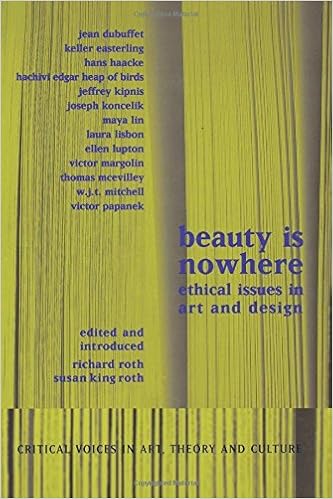
This book is an amalgamation of other books and writing that is around the issue of ethics in art and design. Therefore it has been invaluable when trying to cover a lot of material over a shorter amount of time. Further to this, the shortened sections allow a broader analysis of both art and design in regards to ethics. below are quotes from each section that resonated with me and connect to my practice. I have briefly analysed some to display my thought process when selecting what stood out as vital notions when re considered the industry that stands so highly at the forefront of society.
'Ernesto Leclau proposed that in the face of social and political dilemmas induced by the postmodern era, there is a need to realise a new hegemony of consciousness premised on a recognition of its own precarious state as a structure of various representations'.
Within this section the notion of the new leading consciousness is built on recognising the structural representations of modern power systems. These manifestations of various forms that have been induced are classically reducing consciousness and there is a need to re evaluate the thinking that is brought about throughout the era.
'An ethical task of the art world is that of cognitive decolonisation-to continue the project of dismantling hierarchies, relinquishing privilege, and standing In opposition to forces of exclusion (while not forgetting the ethical significance of play and pleasure).'
The above quote exemplifies a lot of what work outside of the gallery space can do. A Lot of the socially engaged work that is produced in a social space does not have the hierarchy of a label of single authorship. Therefore the work can not be taken as a western work and held above others. This opportunity is vital to remove any outstanding labels regarding non-western art.There is definitely an ethical responsibility of an artist and the art that is produced, this is something that is often ill considered. we are re-affirming our western privilege and therefore modern colonial power if we are not considering the ethics of our work at length. The latter mention of play and pleasure is still vital if done ethically, this aspect keeps a certain aspect of the art alive and therefore more valuable.
Jean Dubuffet (anticultural positions)
'Art will then revert to its true function, a far more effective one than arranging shapes and colours for the supposed delight to the eye' (page 13)
The function of art is debatable and that is part of what makes the practice less respected by other fields. However, at the same time, the fact that there are no strict boundaries means that the open ended possibilities roll out in front of creativity. The art world moulds and changes over time, however, some of the past movements have been labelled as not only art for art's sake but also selfish in the sense they dealt with purely artistic rules and therefore the world they could slot into was pre determined. The model created by them did not allow for progressive thinking or alternate applications of the works. Arts function within society has always been pivotal however, as time progresses and ethics is vital to everyday life, the art world should surely follow suit. I agree with this position and do not agree that there is a case for art in a purely self indulgent visual sense, unless a personal affair with the work is kept.
'Art is a language, an instrument of cognition and communication' (page 14)
My own work deals extensively with classic language however I do not believe that this is always enough to will people toward a certain realisation of position. The use of art as a language and allowing it to play a heavy role within cognition and communication will empower not only the viewer but the cultural format they are part of. Culture grows through non restrictive means, language can sometimes hold these restrictive means and the use of art as language reduces this. This is sort of a thesis that my work deals with and is investigating.
Thomas Mcevilley (What is at stake in the culture wars?)
'From a postmodernism point of view one doesn't necessarily say that that type of study of cultures history is invalid; rather, that type of study will and should continue, but only as part of a more varied scholarly praxis. We now try to look not to lay down the tube but also outside the tube at the same time- to get a little distance on the tunnel vision and see the global situation around it as an enclosed matrix that definitely affects its meaning. As part of our task and responsibility as cultural workers we try to drive out into the open that network of causal connections that links the reality inside the tube to the reality outside it.' (Page 20)
'If Europe was In fact the fittest culture to dominate the rest of the world, then a part of the demonstration of this would be that claim that European art was the most advanced bossy of art in the world' (page 25)
The above quote relates directly to colonisation. However our western art system today still seems to hold its own art and its own 'cultural economy' at a great height above others. Art as elevation is something that is problematic when the work is aiming to engage and not just boast. This is why artist research is vital, to be fully integrated and aware of those around you and what position you may take within society within demanding your work be held at value and remain there. Historical view is very narrow and does not encompass enough within it. Therefore equality is obviously slandered by this lack of holistic viewing. I find myself wondering what gave people the right to produce work with a blind ignorance to the social and ethical implications of that work. It is rife in modern art degree, the lack of engagement with key works, real research both primary and secondary is something greatly lacking in many practices.
'The viewer could become enamoured of the beauty of the view inside the tube to the point where it would distract his attention from the possibility that the social reality going on around might not be comparably beautiful; the beautiful painted cloth then acted as a kind of deceptive veil over a far more difficult and painful reality.' (Page 27)
'In fact, an argument could be constructed to the effect that societies that have featured highly aesthetic arts have tended to be totalitarian, the smooth aesthetic facade acting as a cover up of social reality' (page 32)
The tube analogy within art is a worrying one. I feel as though it is fully in play in many aspects of society now. The visual and aesthetic pleasures that are commonplace in aspects such as consumerism and therefore marketing offer a tunnel vision encouraging people to only exist through the market. The art world may have began this model. It is also present in the very specific working of differing art practices, the end goal of conceptualisation of a work can create a tunnel vision away from the implications that actually producing that work may entail.
'So in its way art is contributing to and participating in the guidance of an apparently momentous opportunity to define history' (page 36)
Victor Papanek (toward the spiritual in design)
Quote chapter at length
Jessica Prinz and Richard Roth (interview with hans haacke)
'The art worlds, part of what has been called the 'consciousness industry' participates in this 'negotiation'. What happens in the art world usually rubs off, not in a mechanical, easily traceable manner but rather at the level of 'atmospherics' I.e of the social and political climate.' (Page 52)
The above quote is partly discussing the indefinable notion of culture and the possibilities that arise from the art industry being allowed self development and continuation. The industry is naturally conscious however commodification has forced the industry to self analyse and justify, therefore making it unwell with targets and over analysis. This is a separate issue to what I discuss in my work, the consideration of art production in terms of sustainability and progression. I have found it difficult to define and separate the two as the link is seemingly intrinsic. Art, as a non-corporate economic model does not produce monetary capital, therefore the government implements social capital wealth as a default target. This is detrimental to creative development for sure. My argument is that within the implemented social and environmental aims of the government, the art industry still stands liable for its place under the corporate systems of function and therefore the non support of such to in turn reduce the oppression of the art industry on a government level.
Laura Lisbon (paintings and ethics: or long for a painting)
'A difficult egotism of the question of the subject is a kind of erotic retain shop of helplessness in the face of the other. It is an obliterating of the known for an engagement with the unknown' (page 162)
'John Rajchman opens his book 'Truth and Eros: Foucault, Lacan and the question of ethics, with what he refers to as 'one of the great questions of science philosophy: What is the Eros of thinking? What is the Eros of the peculiar sort of truth of which philosophy is the pursuit? What is the passion that drives one to philosophise, and that philosophising requires of one?... In our great debates over what is good for us and what is right for us to do we have rather lost the sense in which to do philosophy is to entertain such passionate relations with ourselves and others' (page 169)
Victor Margolin (the politics of the artificial)
This section of the book, discussing the artificial draws nature, artifice and therefore modernity together. The overlapping systems of the modern world, I believe, are mostly a result of market greed. The commodification of many aspects of life was one through borrowing techniques and concepts from other realm, the natural, the political, the cultural and artistic (being the most detrimental). Therefore drawing lines between these now overlapping definitions means that we need to revert to differing thinking, an ancient ruling of what lies where. However, this is not without its own issues as those views and beliefs come with their own outdated preconceived ideas and limitations. The section discusses loss of humanity as a result of this. I worry this is due to the human being removed from the natural realm and moved into the economic area of the model. This therefore would not allow or collective advancement but personal.
'To the degree that design makes incursions into the realms that we once considered as belonging to nature rather that culture' (page 171)
'Which marked the task of humans to invent the artificial world in order to achieve their own goals while honouring the parallel purpose of the natural world' (page 174)
'The act of making, which he (Herbert Simon) called synthesis, while the act of observing-analysis- is the way humans relate to nature' (page 174)
'Carol Christ, ecofeminist, believes that 'the preservation of the Earth required a profound shift in consciousness: a recovery of more ancient and traditional views that revere the profound connection of all being in the web of life and a rethinking of the relation of both humanity and divinity to nature' (page 179)
'To transform the structure of power itself' (page 179)
''Spirituality as a metanarrative-and I interpret spirituality here as a connection to the divine-can serve as a basis for addressing the problems of meaning and reality that have arisen from the expansion of the artificial' (page 180)
'Emphasises power and economics as primary In determining the boundaries of the artificial and the real' (page 181)
'Among those heavily invested in the surgical as a replacement for the natural, resistance to this change is strong. And yet, as the artificial incursion into the natural domain of our lives advances, we may lose part of our humanity' (page 187)


Comments
Post a Comment