Research- THE MARKET Documents of Contemporary Art
Research- THE MARKET
Documents of Contemporary Art
Edited by Natasha Degen
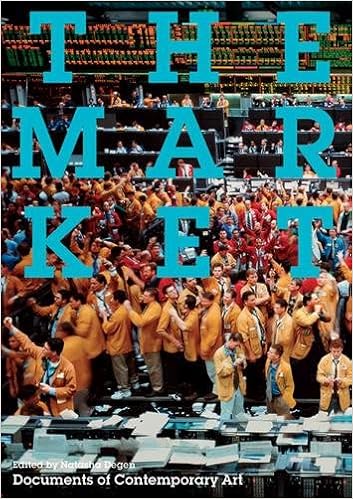
Quotes, notes and reflections on selected Sections
Critique 133
Exchange Rate: On obligation and Reciprocity in some art of the 1960's and after//2003
Miwon Kwon
1960's brought the 'dematerialization' of art (Lucy Lippard) which allowed many different types of art to fall under one category. She later theorised that this had a political narrative also, the conceptual nature behind these works meant that they could not be commodified.
'Anti- establishment fervour in the 1960's focused on the demythologization and de-commodification of art, on the need for independant (or "alternative") art that could not be bought or sold by the greedy sector that owned everything that was exploiting the world and promoting the Vietnam war. The artists who are trying to do non-object rt are introducing a drastic solution to the problems of artist being bought and sold so easily, along with their art' (From the introduction to the 1997 reissue of her book Six years: The dematerialization of the art object from 1966 to 1972) (p134)
What is prominent within this quote is the historical relevance. This type of awareness and critique is as older/older than I am. So although taking this critique and applying it to the modern day art market would be in a way historically reductionist, it does beg the question of if anything has changed, or got worse. Market control has risen since that text was written and artist compliance has also risen. Artists are at constant odds between making a living doing what they love, art, and compromising the morals of not commodifying their work. Having a conceptual practice is becoming increasingly difficult as living costs increase, the time to work as an artist therefore reduces as everything gets squeezed into bracks of commodity or corporate.
Denial of economic materialism
The concept seems 'utopian' now (p135)
'Ideas and actions do not debilitate or escape the market system because they are dematerialized; they drive it precisely because so.' (p135)
The entire market has changed now meaning that information has also become the commodity and experiences of art can be sold just as easily. The section goes on to consider this. The working hypothesis of the author of this section, in relation to 2003 political market standing is very interesting. Many parallels can be drawn between their hypothesis and my own work regarding the ethic-abstraction of a artwork.
'My working hypothesis is as follows. Much of so-called dematerialization art may have complicated the conventional methods of buying and selling art by not conforming to an agreeable and readily exchangeable commodity form. But the radicality, or the intelligence, of such art does not merely lie in its non-object status; the negation of the object form is not an automatic challenge to the abstraction of commodity exchange. I would argue that of greater significance is the fact that many works from the 1960s and 1970s and later- art as idea, art as action, conceptual art, performance art, Happenings, and so on- attempt to install alternative models of exchange that counter, complicate or parody the dominant market- and profit-based systems of exchange' (p135)
This hypothesis implies the praise of artworks that act as a mechanism for something else (outside of market function) and that intend to stand firmly against their own direct commodity and exploitation. The reason I find parallels to my own work is that I think the systems of production behind and artwork can be the dominant force in leading this anti-commodity and acting as one of the aforementioned mechanisms. The material aspect of the artwork remains however its production has been considered, disallowing it to be ironic and also removing the original market support. To make artwork, an artist usually interacts with the market to get materials. If these are non-ethically produced then the artwork is complicit with the market regardless of the aesthetic outcome. This is my own working theory, however, I feel that the above hypothesis runs parallel to my own and will help me develop the historical replacement of my theory, as the above was developed in 2003.
The mention of alternative models of exchange interest me as the technological age has changed this so readily. What does this mean for anti-commodity artwork?
Section goes on to analyse and discuss gift economy.
Gift economy, giving up the artwork, holds both cultural prestige but also aims to democratize the work. By giving over work are you upholding that you are better to give and 'allow' the audience something. Or is there the concept of sharing more firmly involved.
'The hierarchy of relations between the artist as creative thinker/maker and the viewer as disciplined consumer/receiver is not ultimately negated or refuted, as is often claimed. It is rather expressed and legitimized in the very gesture of giving away the ownership of the creative act. Giving things away is tied up with ego-consolidation; abdication of one's authority asserts one's superiority. This is a point that many critics] [continue to miss.' (p137)
References Pierre Bourdieu
The bond being created between audience and artist is at the heart of non-commodity. The moral code of giving and not receiving implies and anti-commodity as the 'object' does not matter. The offering without receiving disallows economic power. (Altruistic art/art embodying altruistic acts)
Art as an investment and Artistic stockholding: Experiments in the 1960s//2013
Sophie Cras
Barbara Rose 1969 article- while that was out artists were making money the material of art itself.
'When Levine, Morris, Graham and Lozano decided to elevate investment to the status of an artwork, they were of course attracted to the diverse forms of financial documentation and Vocabulary, often arid and dull substitutes to potentially exciting and risk-taking ventures. Yet equally important to their enterprise was a concern for what it meant for art to be considered a source of profit rather than enjoyment and for the way that the monetization of cultural production affected the social and institutional framework of the art community.' (p140)
Art Workers Coalition AWC
This section of text focused more on the use of money and inflation as a material. The way in which certain artists used money and investment to point out that rat was becoming the middle man in investment. This clever system is overtly conceptual and therefore is in line with the 1960 notion of dematerialization however takes that a step further by mocking economics from internal systems. Each artist would have had their own stance on capital gain. Some allowed and admitted their art was 'capitalism' however others used this system to point out the ironic nature of modern art and the systems it was increasingly functioning underneath.
The Art Market: Affluence and Degradation//1975
Ian Burn
'Not only do works of art end up as commodities, but there is also an overwhelming sense in which works of art start of as commodities.' (p149)
'What we have seen more recently is the power of market values to distort all other values, so even the concept of what is and is not acceptable as 'work' is defined first and fundamentally by the market and only secondly by 'creative urges' (etc.). This has been the price of internalizing and intensely capitalistic mode of production.' (p149)
1975 reflection- what does that mean for modern day, how much more internalized?
To create successful art (after institutionalisation of art) one must create a market copy, something in line with trends and styles. Personal taste is in part, rendered impossible due to corporate control and marketing.
Alienation-capitalism
Can we produce social practice at all and can artform be removed from american formaism ever again.
(Section photocopied for further analysis)
Answers in my disorder//1976
Carl Andre
Doing away with the art object will not remove the bourgeois ability to purchase anything. Fetishises the idea of exchange all together, partly playing into the hands of the economic ruling class.
What is Money?//1984
Joseph Beuys
'...So that everybody might see, eventually, that in order to escape this dead-end of private capitalism in the West, and centralized state communism in the East, the only way out is by starting from human creativity and from a real capacity for work.' (p154)
Reflections in this section resonate with me as I think there is a great value in everyone thinking and acting in a creative way. I was unaware that Beuys had linked this so explicitly with the freedom from current economic life.
(Section photocopied for physical research file)
Joseph Beuys, or the last of the Proletarians//1988
Thierry de Duve
(Section photocopied for further analysis and reflection)
This section directly considers how material can act as metaphor for the current political taunts of capital control. How Clay specifically can bear the frustrations of strains which modern creativity internalises, especially when working reflective of the market. I hope to reflect on this further in my writing regarding the 'trauma' of clay as a sediment and the way it might act as a metaphor in so many ways.
Documents of Contemporary Art
Edited by Natasha Degen
Quotes, notes and reflections on selected Sections
Critique 133
Exchange Rate: On obligation and Reciprocity in some art of the 1960's and after//2003
Miwon Kwon
1960's brought the 'dematerialization' of art (Lucy Lippard) which allowed many different types of art to fall under one category. She later theorised that this had a political narrative also, the conceptual nature behind these works meant that they could not be commodified.
'Anti- establishment fervour in the 1960's focused on the demythologization and de-commodification of art, on the need for independant (or "alternative") art that could not be bought or sold by the greedy sector that owned everything that was exploiting the world and promoting the Vietnam war. The artists who are trying to do non-object rt are introducing a drastic solution to the problems of artist being bought and sold so easily, along with their art' (From the introduction to the 1997 reissue of her book Six years: The dematerialization of the art object from 1966 to 1972) (p134)
What is prominent within this quote is the historical relevance. This type of awareness and critique is as older/older than I am. So although taking this critique and applying it to the modern day art market would be in a way historically reductionist, it does beg the question of if anything has changed, or got worse. Market control has risen since that text was written and artist compliance has also risen. Artists are at constant odds between making a living doing what they love, art, and compromising the morals of not commodifying their work. Having a conceptual practice is becoming increasingly difficult as living costs increase, the time to work as an artist therefore reduces as everything gets squeezed into bracks of commodity or corporate.
Denial of economic materialism
The concept seems 'utopian' now (p135)
'Ideas and actions do not debilitate or escape the market system because they are dematerialized; they drive it precisely because so.' (p135)
The entire market has changed now meaning that information has also become the commodity and experiences of art can be sold just as easily. The section goes on to consider this. The working hypothesis of the author of this section, in relation to 2003 political market standing is very interesting. Many parallels can be drawn between their hypothesis and my own work regarding the ethic-abstraction of a artwork.
'My working hypothesis is as follows. Much of so-called dematerialization art may have complicated the conventional methods of buying and selling art by not conforming to an agreeable and readily exchangeable commodity form. But the radicality, or the intelligence, of such art does not merely lie in its non-object status; the negation of the object form is not an automatic challenge to the abstraction of commodity exchange. I would argue that of greater significance is the fact that many works from the 1960s and 1970s and later- art as idea, art as action, conceptual art, performance art, Happenings, and so on- attempt to install alternative models of exchange that counter, complicate or parody the dominant market- and profit-based systems of exchange' (p135)
This hypothesis implies the praise of artworks that act as a mechanism for something else (outside of market function) and that intend to stand firmly against their own direct commodity and exploitation. The reason I find parallels to my own work is that I think the systems of production behind and artwork can be the dominant force in leading this anti-commodity and acting as one of the aforementioned mechanisms. The material aspect of the artwork remains however its production has been considered, disallowing it to be ironic and also removing the original market support. To make artwork, an artist usually interacts with the market to get materials. If these are non-ethically produced then the artwork is complicit with the market regardless of the aesthetic outcome. This is my own working theory, however, I feel that the above hypothesis runs parallel to my own and will help me develop the historical replacement of my theory, as the above was developed in 2003.
The mention of alternative models of exchange interest me as the technological age has changed this so readily. What does this mean for anti-commodity artwork?
Section goes on to analyse and discuss gift economy.
Marcel Mauss
The Gift (1924)
Mauss's essay focuses on the way that the exchange of objects between groups builds relationships between humans.
It analyzes the economic practices of various so-called archaic societies and finds that they have a common central practice centered on reciprocal exchange. In them, he finds evidence contrary to the presumptions of modern Western societies about the history and nature of exchange. He shows that early exchange systems center around the obligations to give, to receive, and, most importantly, to reciprocate. They occur between groups, not only individuals, and they are a crucial part of “total phenomena” that work to build not just wealth and alliances but social solidarity because “the gift” pervades all aspects of the society. He uses a comparative method, drawing upon published secondary scholarship on peoples from around the world, but especially the Pacific Northwest (especially potlatch).
After examining the reciprocal gift-giving practices of each, he finds in them common features, despite some variation. From the disparate evidence, he builds a case for a foundation to human society based on collective (vs. individual) exchange practices. In so doing, he refutes the English tradition of liberal thought, such as utilitarianism, as distortions of human exchange practices. He concludes by speculating that social welfare programs may be recovering some aspects of the morality of the gift within modern market economies.
Gift economy, giving up the artwork, holds both cultural prestige but also aims to democratize the work. By giving over work are you upholding that you are better to give and 'allow' the audience something. Or is there the concept of sharing more firmly involved.
'The hierarchy of relations between the artist as creative thinker/maker and the viewer as disciplined consumer/receiver is not ultimately negated or refuted, as is often claimed. It is rather expressed and legitimized in the very gesture of giving away the ownership of the creative act. Giving things away is tied up with ego-consolidation; abdication of one's authority asserts one's superiority. This is a point that many critics] [continue to miss.' (p137)
References Pierre Bourdieu
The bond being created between audience and artist is at the heart of non-commodity. The moral code of giving and not receiving implies and anti-commodity as the 'object' does not matter. The offering without receiving disallows economic power. (Altruistic art/art embodying altruistic acts)
Art as an investment and Artistic stockholding: Experiments in the 1960s//2013
Sophie Cras
Barbara Rose 1969 article- while that was out artists were making money the material of art itself.
'When Levine, Morris, Graham and Lozano decided to elevate investment to the status of an artwork, they were of course attracted to the diverse forms of financial documentation and Vocabulary, often arid and dull substitutes to potentially exciting and risk-taking ventures. Yet equally important to their enterprise was a concern for what it meant for art to be considered a source of profit rather than enjoyment and for the way that the monetization of cultural production affected the social and institutional framework of the art community.' (p140)
Art Workers Coalition AWC
This section of text focused more on the use of money and inflation as a material. The way in which certain artists used money and investment to point out that rat was becoming the middle man in investment. This clever system is overtly conceptual and therefore is in line with the 1960 notion of dematerialization however takes that a step further by mocking economics from internal systems. Each artist would have had their own stance on capital gain. Some allowed and admitted their art was 'capitalism' however others used this system to point out the ironic nature of modern art and the systems it was increasingly functioning underneath.
The Art Market: Affluence and Degradation//1975
Ian Burn
'Not only do works of art end up as commodities, but there is also an overwhelming sense in which works of art start of as commodities.' (p149)
'What we have seen more recently is the power of market values to distort all other values, so even the concept of what is and is not acceptable as 'work' is defined first and fundamentally by the market and only secondly by 'creative urges' (etc.). This has been the price of internalizing and intensely capitalistic mode of production.' (p149)
1975 reflection- what does that mean for modern day, how much more internalized?
To create successful art (after institutionalisation of art) one must create a market copy, something in line with trends and styles. Personal taste is in part, rendered impossible due to corporate control and marketing.
Alienation-capitalism
Can we produce social practice at all and can artform be removed from american formaism ever again.
(Section photocopied for further analysis)
Answers in my disorder//1976
Carl Andre
Doing away with the art object will not remove the bourgeois ability to purchase anything. Fetishises the idea of exchange all together, partly playing into the hands of the economic ruling class.
What is Money?//1984
Joseph Beuys
'...So that everybody might see, eventually, that in order to escape this dead-end of private capitalism in the West, and centralized state communism in the East, the only way out is by starting from human creativity and from a real capacity for work.' (p154)
Reflections in this section resonate with me as I think there is a great value in everyone thinking and acting in a creative way. I was unaware that Beuys had linked this so explicitly with the freedom from current economic life.
(Section photocopied for physical research file)
Joseph Beuys, or the last of the Proletarians//1988
Thierry de Duve
(Section photocopied for further analysis and reflection)
This section directly considers how material can act as metaphor for the current political taunts of capital control. How Clay specifically can bear the frustrations of strains which modern creativity internalises, especially when working reflective of the market. I hope to reflect on this further in my writing regarding the 'trauma' of clay as a sediment and the way it might act as a metaphor in so many ways.


Comments
Post a Comment