Research: ETHICS, Whitechapel published book (multiple authors).
Research: ETHICS, Whitechapel published book containing may authors.
ETHICS
Whitechapel
Edited by Walead Beshty
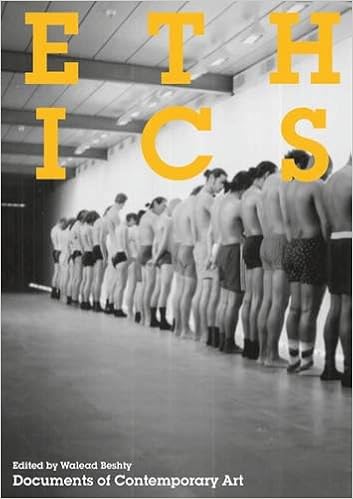
I was hoping to get this book to read and work with for my Ba2a essay however unfortunately someone had it for an extended period of time which meant I couldn't not utilise it fully if at all. Considering my themes and patterns of work continue unit after unit through my conceptual and material development, using this book in my research will still be vastly beneficial to my practice, understanding and actions.
Introduction
The introduction of this book begins by explaining that the book does not deal with the shift in contemporary art from visuality to a conceptual and thematic field. The reason for this is due to that shift being intensely complicated and would deserve its own volume. I, within my work, have begun to investigate this and my last paper was on this subject, I briefly dealt with the historical factors also however agree with the vast historical context that is vital to understand but incredibly complex to explain/have complete knowledge off. Therefore this is why I continue to read extensively, especially books such as this, and political non-art based books to ground my mind fully in the preset situation, compare that to the past and theorise for the future. The introduction also mentions Brancusi's floor placed sculpture. This had vast connotations and at the time varied interpretations that then become revised. I place my own work on ground level very often and have never investigated why I felt such an urge to do so. This may be an interesting aspect to investigate therefore as I may discover not only some rational for when people ask, which they do. But also so contextual and historical implications of that curatorial decision.
Art as Pact/Art as Social Contract'... artworks not only are products of given circumstances, they also contribute to the existence of these very circumstances'- Dorothea Von Hantelmaann, How to do things with art (2010)
Hantelmaann's words are reminiscent of a movement into consciousness. Unfortunately this consciousness shift and drive is still in need of a push today. Hence why my own work, writing and action move toward the same awareness. Her observations are pointing out a number of ironies within the art world and the Eve growing elitism that exists within that when the overarching consisting are oppressive or unfair. This is something we have seen a rise in over the past few years and discovering ethics in all walks of life will be a vital step towards change. The social and political implications have mattered for a long time and been read into but previous consideration should joe be in play.
Ethics and morals'The moral and true ethical are often practically at odds. An individual who assets a morally acceptable I.e normatively correct or just, position can deploy unethical means to achieve it. Within aesthetics, consider the use of propaganda: the message of propaganda may be morally 'correct', seeking to promote positive action, but may also be unethical, in that it subordinates a viewer, addressing them in a coercive or threatening manner, or by appealing to fears of prejudices. This is the paradox of political art that deploys propagandistic forms. While such a work might call for freedom of repression, it deploys a mode of address that assumes self-validating authority nonetheless, a reification of the very power it claims to usurp' (page 20, introduction)
Locating ethics, situating aesthetics
Alain Badiou- Ethics: An essay in the understanding of evil//1993
'Ethics concerns, in Greek, the search for a good way of being, for a wise course of action. On this account, ethics is part of philosophy, that part which organises practical existence around representations of being good' (page 26)
Kant- 'ethics of judgement'
Hegel- 'ethics of decision'
Aristotle- 'the Nicomachean ethics' the good 'way of being'
Giorgio Agamben
-leading figure in radical political theory and Italian philosophy
Form-of-life//1993
This section of the book contained discussion of naked life and what could be labelled as 'ethical life' all the rest that falls under the human condition and that which is likely separate from other 'animals' that have naked life. This piece of writing had extensive references of other philosophical and theoretical figures such as Walter Benjamin and Dante the poet. All of these allowed me to understand the explanation and groundings better due to my prior reading of those individuals. Regardless of this, the text is still very 'critical text' style with many references and explanations that require a little more backing than I have. My interpretation l if the work is the discussion of the more complicated aspects of life such as political and structural that now can not be taken down to naked life and the inseparable relationships that had formed.
'This is why modern political philosophy does not begin with classical thought, which had made of contemplation, of the bios theoreticos, a separate and solitary activity (exile of the alone to the alone) but rather only with averroism, that is, with the thought of the one and only possible intellect common to all human beings, and crucially, with Dante's affirmation in De Monarchia of the inheritance of a multitude to the very power of thought' (Page 30)
I think further research into this writing and the specific references made will allow me to further and better engage with this piece of philosophical writing. It is interesting that it was written in 1993 due to the fact I feel it is a lot more dated than that. The internal muses are something that I thought were already considered and theorised more at that time. However, the introduction of capitalism is something that is mentioned which of course didn't start takin excessive flight until around that time. Therefore this brings it back to the historical grounding in its reflections.
'The act of distinguishing between the mere, massive inscription of social knowledge into the productive processes (an inscription that characterises the contemporary phase of capitalism, the society of the spectacle) and intellectuality as antagonistic power and form-of-life such an act passed through the experience of this cohesion and this inseparability. ' (Page 30)
Jacques RancièreThe distribution of the sensible: Politics and Aesthetics//2000
'There is this an 'aesthetics' at the core of politics that has nothing to do with Walter Benjamin's discussion of the 'aestheticisation of politics' specific to the 'age of the masses'. (Page 32)
'Politics revolves around what is seen and what can be said about it, around who has the ability to see and the talent to speak, around the properties of spaces and the possibilities of time' (page 32)
(Photography of Page 33)
I have already noticed in this book that the word politics seems to be featuring very heavily. Sometimes I relation to internal politics of things an flow they therefore relate to one another but also politics on the classic sense of the word meaning the political features of things including art. This is very interesting as my own conception of ethics is also inseparable from politics and visa Versa. The investigation of such has been vital over time especially when ethics of politics is concerned. This link to the art word and the references I am finding are helpful very helpful in support of my own visions and work.
Simon CritchleyInfinitely Demanding: Ethics of Commitment, Politics of resistance //2007
'So, on my view, the ethical subject is defined by commitment or fidelity to an unfulfillable demand, a demand that is internalised subjectively and which divides subjectivity'. (Page 34)
Divided subjectivity= 'experience of conscience' (an experience at the heart of ethics)
'At the heart of radical politics there hasty be what I call a meta-political ethical moment that provides the motivational force or propulsion into political action. If ethics without politics is empty, then politics without ethics is blind' (page 35)
Jean-François Lyotard and Jean-LoupThébaud
Just Gaming 1979
'Forms of language that are at the same time unexpected and unheard of, as forms of efficacy. Either because one has made up new moves in an old game or because one has made up a new game' (page 36)
'They can move from one game to another, and in each of these games (in the optimal situation) they try to figure out new news' (Page 37)
The above quotes from the section 'just gaming' really resonate with me as I often discuss the concept of fluid praxis and things intertwining together and informing one another. I think this is what the differing 'games' was referring to but ultimately it is quite hard to tell in any conversation/interview outtake section. There is reduction of context massively so the reader will never be able to fully understand what the two 'subjects' are discussing or the tone of the conversation.
Regardless of this however, I agree with the differing 'rules' and regulations set to things that seem to be unquestionable e.g thou shall not kill's questionability. I think the link to religion is what was mainly lost on me along with the extensive pagan references.
Nicolas BourriaudRelational Aesthetics//1998(Read in 1st year)
'The role of artworks is no longer to form imaginary and utopian realities, but actually to be ways of living and models of action within the existing real' (page 40)
I read Bourriaud's work in 1st year and it was pivotal in understanding that art is already a communicative weapon. It allowed me to develop the concept that artwork is already a message of sorts and the outer interaction that then becomes from the work is the relation to the public. This over time has stopped me making overtly political works hat could be reminiscent of propaganda.I agree that artwork now has transcended into something completely different and the 'use' of art is much more vital in raising awareness of things in relational aesthetics terms. The political interface of work that is produced as a smaller exchange in moderns society does however cause a lot of issues due to the value that is then placed in that exchange in the commodified world. It still remains vital though as a tool of cultural production. I think what might be useful to me is if I read this book again a year later with a much better understanding of the art world around me as well as my own 'plans' for the future.
Grant KesterOn 'the contemporary'//2009
‘Reception theory’
‘This is due in part to the tendency in much recent scholarship to simply import generic re Elton models taken from traditions of post-structuralist literary and critical theory into the analysis of contemporary art.’
‘The result has been the emergence of a quasi-canonical body of art theory centred on the notion of the artwork as subversive text that seeks to destabilise or otherwise disrupt the viewers preconceptions.’ P.44
I have read previously about the ways in which historical readings and themes are mounted onto the modern ones in a sort of uncomfortable stitch. Attached together through the ‘same’ themes however set apart by a number of years, and therefore by the history that troubles those years. Therefore the new area of artists theory regarding reading theory and reception theory are vastly interesting. The way the work it received it not received is a vital aspect of you are asking your viewer to look internally and question what they know already/ don’t know. The theoretical separation allows the art to stand up as ‘art object’ and a work of art in its own right and the theoretical consideration does the research for the work, justifying or condemning its existence.
Eyal Weizmann
Forensic architecture: Notes from fields and forums//2011
‘Architecture, I once proposed, is ‘political plastic’ social forces slowing into form’ .p46
Architecture is something that has been featuring in my research much more readily. The ways in which design and execution function together to offer a political and practical commentary. The constantly changing styles and lives of a building suggest the histories that run alongside them. The destruction of buildings and the use of them to house and protect. Internal space of structures have housed the biggest decisions, crimes, live stories of all time. There memory alive in the walls as the building ages and remembers itself. My own work doesn’t reflect on architecture very often and I’m not sure I plan to, however, doing research into a different area of aesthetics and visual theory is very helpful. The way that my own theories fall into the ‘everyday’ can be run parallel to architecture and function of the aesthetic.
To criticise or to intervene
Keller Easterling
Believers and cheaters//2005
‘The multiplication of dictions that protects the believer or the cheater may also offer an opportunity for subversion, mischief or political ingenuity. The familiar script of activism harbour their own political theologies and pious righteousness.’ P.53
This text again discussed architecture, however it discussed it in a very different manner. Is discussed the criminalisation of architecture and the way in which the profession views itself and a hierarchy. This is interesting as the creative person and therefore the creative object are usually heals high in regard of respect and viewers as ‘good’ not evil, they are the believers and rarely the cheaters. However the mix of both is what makes a genuine and believer and a genuine cheater. I think my own alternative commentary in my worn puts me in both categories. The ways I offer a different view and call our the issues within art contradicts the way in which I am still practicing as an artist underneath the artist power structure that I offer commentary on.
David Hammons
In conversation with Kellie Jones//1986
‘If an artist doesn’t have his own rules then he’s playing with those of the art world, and you know those are stacked against you’. P.57
This interview with Jones highlights an interesting interface between the gallery art and the street art executed. Discussing the logistics of New York, the ways in which the audience is more responsive and human on the streets. The gallery has become a different type of place and as people are more likely now to read I to clothing, hair and media the role of art has shifted considerably. I think this shift is somewhat domestic in the sense that the things being read into are domestic. Therefore, on the street is the only ‘real’ place where opinion may now stand. In the gallery there is many games being played, however, realising this is pivotal. Realising that the middle class Welle ducted audience will be your viewer allows you to tailor the art with messages directly for them.
Martha Rosler
The concerns of art//1979
‘The words agitations and propaganda evoke a familiar negative response in us. They call up pictures of clenched-fist posters, yet it should be without saying that only crude works of agitation and propaganda are crude, and only those that offend our ideological precepts are dismissed out of hand’p.61
The relationship between the viewer and artist is presumed passive and the art world implies that passivity to retain hierarchy. However, in genuine consideration of the historical waves of audience and art type this is lot always true as political and social art have championed the change in this. The more fluid existence of this relationship is a development since this piece of writing. We now overlook our audience heavily and sometimes consider the audience implications before the work is produced.
Andrea Fraser
An artist stammet//1992
‘My Engagement in institutional critique follows from the fact that as an artist and a writer, to the extent that I write, art and academic institutions are the sites where my activity is located’.p62
‘...my distance from the class whose culture I produce....’p.64
This artist statement is a personal one that interests me as there is a clear ethical narrative. This narrative allows it to be situated across a number of areas, ethical, institutional and hierarchical. The way it is written is academic, so wie what ironic considering the themes explored within the writing. This is something I aim to not do in my own work however it can be a really struggle often to choice the correct language that embodies exactly what you are trying to say without being overtly academic. The reality of writing as an artist means you are alienating a massive section of society. Two rows run fluidly in artist practice and the expected use of a certain language is not its intended interpretation.
Jacques Rancière
Some Paradoxes of Political Art//2005
‘The Problem then has to do with the moral or political validity of the message transmitted by the representative device.’ P.67
Arts aesthetic regime
‘What aesthetics means most fundamentally is not the contemplation of the beautiful it rather the suspension of any direct relationship between the production of forms of art and the provision of determinate effect on a determinate audience.’ P68
‘The aesthetic rupture thus establishes a singular form of efficacy: the efficacy of a disconnection, a rupture, a breakdown in the relationship between productions involving artistic know-how and of defined social objectives, between sense-based forms, the meaning that one can read in them and the effects which they are liable to bring about. In other words, it established the efficacy of dissension.’p69
Picture of page 69
This piece of writing is a very interesting outlook on political art and runs parallel to some of the paradoxes that I have. I too focus on the ironic aims of overt political art as an unachievable commentary in an already saturated world in terms of the visual. The overwhelmed media senses are not affected by a slogan or a statue of a well known dictator. These stands are not political in the sense that they are publicity and only elicit medium aesthetic Response. If aesthetic effect is used wholly then the consideration would be more based on a material and ethical consideration level. Art work Made without purpose and in an experimental manner but just with a more ethnically backing. This ethical backing and relaxed creative flow is political in itself as it stands against the saturated flow of current visual culture.
Andrea Fraser
There’s no place like home//2012
‘ if the artistic negation Bourdieu described Indeed functions defensively, in a psychoanalytical sense, then the primary object of those defences may in fact be the conflicts attendant to the economic conditions of art and our complicity in the economic domination- and spreading impoverishment that the enormous wealth within the art world represents.’p.70
‘ It often seems that the very process of the conceptualisation of social and psychological structures in art, and above all, in the art discourse in which these conceptualisation s are articulated, has the consequence of distancing and derealised them; of splitting them off from the social and psychology al relations that we may be producing and reproducing in the very same activities of making and engaging with art.’p 72
Merlin Carpenter
The tail that wags the dog: a lecture for art center in Pasadena, Not delivered//2008
(Would be an inaccessible text to most which goes full circle when analysing art in place of consumption) (Argues its own way out of progressive conclusions)
‘...Critique is required to rescue art from ritual’ (page 76)
Understanding the networks of critical working and the ways in which they interact with the art world an dart market. The commodification of art and the critics shift to justify that/make some work more and less sellable. Historical analysis of the power shifts post Iraq.
This chapter further to the consideration of why art students are so professionalised. Although there are many struggles that ended in leftist positions, the system is still overtly conservative, the system that is producing the artists of today.
‘Politics as actual content can never appear, because that is all that can appear, in form of the shadows’ p78
The reflections on transparency within this chapter are interesting as it addresses the issues with the concept. Along with the networks that it reinforces.

ETHICS
Whitechapel
Edited by Walead Beshty
I was hoping to get this book to read and work with for my Ba2a essay however unfortunately someone had it for an extended period of time which meant I couldn't not utilise it fully if at all. Considering my themes and patterns of work continue unit after unit through my conceptual and material development, using this book in my research will still be vastly beneficial to my practice, understanding and actions.
Introduction
The introduction of this book begins by explaining that the book does not deal with the shift in contemporary art from visuality to a conceptual and thematic field. The reason for this is due to that shift being intensely complicated and would deserve its own volume. I, within my work, have begun to investigate this and my last paper was on this subject, I briefly dealt with the historical factors also however agree with the vast historical context that is vital to understand but incredibly complex to explain/have complete knowledge off. Therefore this is why I continue to read extensively, especially books such as this, and political non-art based books to ground my mind fully in the preset situation, compare that to the past and theorise for the future. The introduction also mentions Brancusi's floor placed sculpture. This had vast connotations and at the time varied interpretations that then become revised. I place my own work on ground level very often and have never investigated why I felt such an urge to do so. This may be an interesting aspect to investigate therefore as I may discover not only some rational for when people ask, which they do. But also so contextual and historical implications of that curatorial decision.
Art as Pact/Art as Social Contract'... artworks not only are products of given circumstances, they also contribute to the existence of these very circumstances'- Dorothea Von Hantelmaann, How to do things with art (2010)
Hantelmaann's words are reminiscent of a movement into consciousness. Unfortunately this consciousness shift and drive is still in need of a push today. Hence why my own work, writing and action move toward the same awareness. Her observations are pointing out a number of ironies within the art world and the Eve growing elitism that exists within that when the overarching consisting are oppressive or unfair. This is something we have seen a rise in over the past few years and discovering ethics in all walks of life will be a vital step towards change. The social and political implications have mattered for a long time and been read into but previous consideration should joe be in play.
Ethics and morals'The moral and true ethical are often practically at odds. An individual who assets a morally acceptable I.e normatively correct or just, position can deploy unethical means to achieve it. Within aesthetics, consider the use of propaganda: the message of propaganda may be morally 'correct', seeking to promote positive action, but may also be unethical, in that it subordinates a viewer, addressing them in a coercive or threatening manner, or by appealing to fears of prejudices. This is the paradox of political art that deploys propagandistic forms. While such a work might call for freedom of repression, it deploys a mode of address that assumes self-validating authority nonetheless, a reification of the very power it claims to usurp' (page 20, introduction)
Locating ethics, situating aesthetics
Alain Badiou- Ethics: An essay in the understanding of evil//1993
'Ethics concerns, in Greek, the search for a good way of being, for a wise course of action. On this account, ethics is part of philosophy, that part which organises practical existence around representations of being good' (page 26)
Kant- 'ethics of judgement'
Hegel- 'ethics of decision'
Aristotle- 'the Nicomachean ethics' the good 'way of being'
Giorgio Agamben
-leading figure in radical political theory and Italian philosophy
Form-of-life//1993
This section of the book contained discussion of naked life and what could be labelled as 'ethical life' all the rest that falls under the human condition and that which is likely separate from other 'animals' that have naked life. This piece of writing had extensive references of other philosophical and theoretical figures such as Walter Benjamin and Dante the poet. All of these allowed me to understand the explanation and groundings better due to my prior reading of those individuals. Regardless of this, the text is still very 'critical text' style with many references and explanations that require a little more backing than I have. My interpretation l if the work is the discussion of the more complicated aspects of life such as political and structural that now can not be taken down to naked life and the inseparable relationships that had formed.
'This is why modern political philosophy does not begin with classical thought, which had made of contemplation, of the bios theoreticos, a separate and solitary activity (exile of the alone to the alone) but rather only with averroism, that is, with the thought of the one and only possible intellect common to all human beings, and crucially, with Dante's affirmation in De Monarchia of the inheritance of a multitude to the very power of thought' (Page 30)
I think further research into this writing and the specific references made will allow me to further and better engage with this piece of philosophical writing. It is interesting that it was written in 1993 due to the fact I feel it is a lot more dated than that. The internal muses are something that I thought were already considered and theorised more at that time. However, the introduction of capitalism is something that is mentioned which of course didn't start takin excessive flight until around that time. Therefore this brings it back to the historical grounding in its reflections.
'The act of distinguishing between the mere, massive inscription of social knowledge into the productive processes (an inscription that characterises the contemporary phase of capitalism, the society of the spectacle) and intellectuality as antagonistic power and form-of-life such an act passed through the experience of this cohesion and this inseparability. ' (Page 30)
Jacques RancièreThe distribution of the sensible: Politics and Aesthetics//2000
'There is this an 'aesthetics' at the core of politics that has nothing to do with Walter Benjamin's discussion of the 'aestheticisation of politics' specific to the 'age of the masses'. (Page 32)
'Politics revolves around what is seen and what can be said about it, around who has the ability to see and the talent to speak, around the properties of spaces and the possibilities of time' (page 32)
(Photography of Page 33)
I have already noticed in this book that the word politics seems to be featuring very heavily. Sometimes I relation to internal politics of things an flow they therefore relate to one another but also politics on the classic sense of the word meaning the political features of things including art. This is very interesting as my own conception of ethics is also inseparable from politics and visa Versa. The investigation of such has been vital over time especially when ethics of politics is concerned. This link to the art word and the references I am finding are helpful very helpful in support of my own visions and work.
Simon CritchleyInfinitely Demanding: Ethics of Commitment, Politics of resistance //2007
'So, on my view, the ethical subject is defined by commitment or fidelity to an unfulfillable demand, a demand that is internalised subjectively and which divides subjectivity'. (Page 34)
Divided subjectivity= 'experience of conscience' (an experience at the heart of ethics)
'At the heart of radical politics there hasty be what I call a meta-political ethical moment that provides the motivational force or propulsion into political action. If ethics without politics is empty, then politics without ethics is blind' (page 35)
Jean-François Lyotard and Jean-LoupThébaud
Just Gaming 1979
'Forms of language that are at the same time unexpected and unheard of, as forms of efficacy. Either because one has made up new moves in an old game or because one has made up a new game' (page 36)
'They can move from one game to another, and in each of these games (in the optimal situation) they try to figure out new news' (Page 37)
The above quotes from the section 'just gaming' really resonate with me as I often discuss the concept of fluid praxis and things intertwining together and informing one another. I think this is what the differing 'games' was referring to but ultimately it is quite hard to tell in any conversation/interview outtake section. There is reduction of context massively so the reader will never be able to fully understand what the two 'subjects' are discussing or the tone of the conversation.
Regardless of this however, I agree with the differing 'rules' and regulations set to things that seem to be unquestionable e.g thou shall not kill's questionability. I think the link to religion is what was mainly lost on me along with the extensive pagan references.
Nicolas BourriaudRelational Aesthetics//1998(Read in 1st year)
'The role of artworks is no longer to form imaginary and utopian realities, but actually to be ways of living and models of action within the existing real' (page 40)
I read Bourriaud's work in 1st year and it was pivotal in understanding that art is already a communicative weapon. It allowed me to develop the concept that artwork is already a message of sorts and the outer interaction that then becomes from the work is the relation to the public. This over time has stopped me making overtly political works hat could be reminiscent of propaganda.I agree that artwork now has transcended into something completely different and the 'use' of art is much more vital in raising awareness of things in relational aesthetics terms. The political interface of work that is produced as a smaller exchange in moderns society does however cause a lot of issues due to the value that is then placed in that exchange in the commodified world. It still remains vital though as a tool of cultural production. I think what might be useful to me is if I read this book again a year later with a much better understanding of the art world around me as well as my own 'plans' for the future.
Grant KesterOn 'the contemporary'//2009
‘Reception theory’
‘This is due in part to the tendency in much recent scholarship to simply import generic re Elton models taken from traditions of post-structuralist literary and critical theory into the analysis of contemporary art.’
‘The result has been the emergence of a quasi-canonical body of art theory centred on the notion of the artwork as subversive text that seeks to destabilise or otherwise disrupt the viewers preconceptions.’ P.44
I have read previously about the ways in which historical readings and themes are mounted onto the modern ones in a sort of uncomfortable stitch. Attached together through the ‘same’ themes however set apart by a number of years, and therefore by the history that troubles those years. Therefore the new area of artists theory regarding reading theory and reception theory are vastly interesting. The way the work it received it not received is a vital aspect of you are asking your viewer to look internally and question what they know already/ don’t know. The theoretical separation allows the art to stand up as ‘art object’ and a work of art in its own right and the theoretical consideration does the research for the work, justifying or condemning its existence.
Eyal Weizmann
Forensic architecture: Notes from fields and forums//2011
‘Architecture, I once proposed, is ‘political plastic’ social forces slowing into form’ .p46
Architecture is something that has been featuring in my research much more readily. The ways in which design and execution function together to offer a political and practical commentary. The constantly changing styles and lives of a building suggest the histories that run alongside them. The destruction of buildings and the use of them to house and protect. Internal space of structures have housed the biggest decisions, crimes, live stories of all time. There memory alive in the walls as the building ages and remembers itself. My own work doesn’t reflect on architecture very often and I’m not sure I plan to, however, doing research into a different area of aesthetics and visual theory is very helpful. The way that my own theories fall into the ‘everyday’ can be run parallel to architecture and function of the aesthetic.
To criticise or to intervene
Keller Easterling
Believers and cheaters//2005
‘The multiplication of dictions that protects the believer or the cheater may also offer an opportunity for subversion, mischief or political ingenuity. The familiar script of activism harbour their own political theologies and pious righteousness.’ P.53
This text again discussed architecture, however it discussed it in a very different manner. Is discussed the criminalisation of architecture and the way in which the profession views itself and a hierarchy. This is interesting as the creative person and therefore the creative object are usually heals high in regard of respect and viewers as ‘good’ not evil, they are the believers and rarely the cheaters. However the mix of both is what makes a genuine and believer and a genuine cheater. I think my own alternative commentary in my worn puts me in both categories. The ways I offer a different view and call our the issues within art contradicts the way in which I am still practicing as an artist underneath the artist power structure that I offer commentary on.
David Hammons
In conversation with Kellie Jones//1986
‘If an artist doesn’t have his own rules then he’s playing with those of the art world, and you know those are stacked against you’. P.57
This interview with Jones highlights an interesting interface between the gallery art and the street art executed. Discussing the logistics of New York, the ways in which the audience is more responsive and human on the streets. The gallery has become a different type of place and as people are more likely now to read I to clothing, hair and media the role of art has shifted considerably. I think this shift is somewhat domestic in the sense that the things being read into are domestic. Therefore, on the street is the only ‘real’ place where opinion may now stand. In the gallery there is many games being played, however, realising this is pivotal. Realising that the middle class Welle ducted audience will be your viewer allows you to tailor the art with messages directly for them.
Martha Rosler
The concerns of art//1979
‘The words agitations and propaganda evoke a familiar negative response in us. They call up pictures of clenched-fist posters, yet it should be without saying that only crude works of agitation and propaganda are crude, and only those that offend our ideological precepts are dismissed out of hand’p.61
The relationship between the viewer and artist is presumed passive and the art world implies that passivity to retain hierarchy. However, in genuine consideration of the historical waves of audience and art type this is lot always true as political and social art have championed the change in this. The more fluid existence of this relationship is a development since this piece of writing. We now overlook our audience heavily and sometimes consider the audience implications before the work is produced.
Andrea Fraser
An artist stammet//1992
‘My Engagement in institutional critique follows from the fact that as an artist and a writer, to the extent that I write, art and academic institutions are the sites where my activity is located’.p62
‘...my distance from the class whose culture I produce....’p.64
This artist statement is a personal one that interests me as there is a clear ethical narrative. This narrative allows it to be situated across a number of areas, ethical, institutional and hierarchical. The way it is written is academic, so wie what ironic considering the themes explored within the writing. This is something I aim to not do in my own work however it can be a really struggle often to choice the correct language that embodies exactly what you are trying to say without being overtly academic. The reality of writing as an artist means you are alienating a massive section of society. Two rows run fluidly in artist practice and the expected use of a certain language is not its intended interpretation.
Jacques Rancière
Some Paradoxes of Political Art//2005
‘The Problem then has to do with the moral or political validity of the message transmitted by the representative device.’ P.67
Arts aesthetic regime
‘What aesthetics means most fundamentally is not the contemplation of the beautiful it rather the suspension of any direct relationship between the production of forms of art and the provision of determinate effect on a determinate audience.’ P68
‘The aesthetic rupture thus establishes a singular form of efficacy: the efficacy of a disconnection, a rupture, a breakdown in the relationship between productions involving artistic know-how and of defined social objectives, between sense-based forms, the meaning that one can read in them and the effects which they are liable to bring about. In other words, it established the efficacy of dissension.’p69
Picture of page 69
This piece of writing is a very interesting outlook on political art and runs parallel to some of the paradoxes that I have. I too focus on the ironic aims of overt political art as an unachievable commentary in an already saturated world in terms of the visual. The overwhelmed media senses are not affected by a slogan or a statue of a well known dictator. These stands are not political in the sense that they are publicity and only elicit medium aesthetic Response. If aesthetic effect is used wholly then the consideration would be more based on a material and ethical consideration level. Art work Made without purpose and in an experimental manner but just with a more ethnically backing. This ethical backing and relaxed creative flow is political in itself as it stands against the saturated flow of current visual culture.
Andrea Fraser
There’s no place like home//2012
‘ if the artistic negation Bourdieu described Indeed functions defensively, in a psychoanalytical sense, then the primary object of those defences may in fact be the conflicts attendant to the economic conditions of art and our complicity in the economic domination- and spreading impoverishment that the enormous wealth within the art world represents.’p.70
‘ It often seems that the very process of the conceptualisation of social and psychological structures in art, and above all, in the art discourse in which these conceptualisation s are articulated, has the consequence of distancing and derealised them; of splitting them off from the social and psychology al relations that we may be producing and reproducing in the very same activities of making and engaging with art.’p 72
Merlin Carpenter
The tail that wags the dog: a lecture for art center in Pasadena, Not delivered//2008
(Would be an inaccessible text to most which goes full circle when analysing art in place of consumption) (Argues its own way out of progressive conclusions)
‘...Critique is required to rescue art from ritual’ (page 76)
Understanding the networks of critical working and the ways in which they interact with the art world an dart market. The commodification of art and the critics shift to justify that/make some work more and less sellable. Historical analysis of the power shifts post Iraq.
This chapter further to the consideration of why art students are so professionalised. Although there are many struggles that ended in leftist positions, the system is still overtly conservative, the system that is producing the artists of today.
‘Politics as actual content can never appear, because that is all that can appear, in form of the shadows’ p78
The reflections on transparency within this chapter are interesting as it addresses the issues with the concept. Along with the networks that it reinforces.

The merging of market place as a force of influence in the art world.
'...information itself is also institutional power and wealth' p.79
ADD TO DISSERTATION- Reflective of what it means to engage in critique from inside an institution. Although we are aware of these hypocrasise, does that mean we need stop the ethical consideration?
'All cultural producers are critics, all are involved with marketing information and are thereby involved with the politics of knowledge. Information is the institution. If we- we are all critics- are the institution, then institutional critique is of ourselves and our role as value suppliers at the margins of a huge cultural industry. reading books adds value, it is not necessarily liberatory, it could be functionalized factory farming of info, reading = capitalist writing. Theory and politics may not be an escape route any more. Art may be one of the border forms that allow them to be marketed.' p81 Yes, art could be however, creativity may not be if we restrict what we 'sell' it to.
'...information itself is also institutional power and wealth' p.79
ADD TO DISSERTATION- Reflective of what it means to engage in critique from inside an institution. Although we are aware of these hypocrasise, does that mean we need stop the ethical consideration?
'All cultural producers are critics, all are involved with marketing information and are thereby involved with the politics of knowledge. Information is the institution. If we- we are all critics- are the institution, then institutional critique is of ourselves and our role as value suppliers at the margins of a huge cultural industry. reading books adds value, it is not necessarily liberatory, it could be functionalized factory farming of info, reading = capitalist writing. Theory and politics may not be an escape route any more. Art may be one of the border forms that allow them to be marketed.' p81 Yes, art could be however, creativity may not be if we restrict what we 'sell' it to.


Comments
Post a Comment